
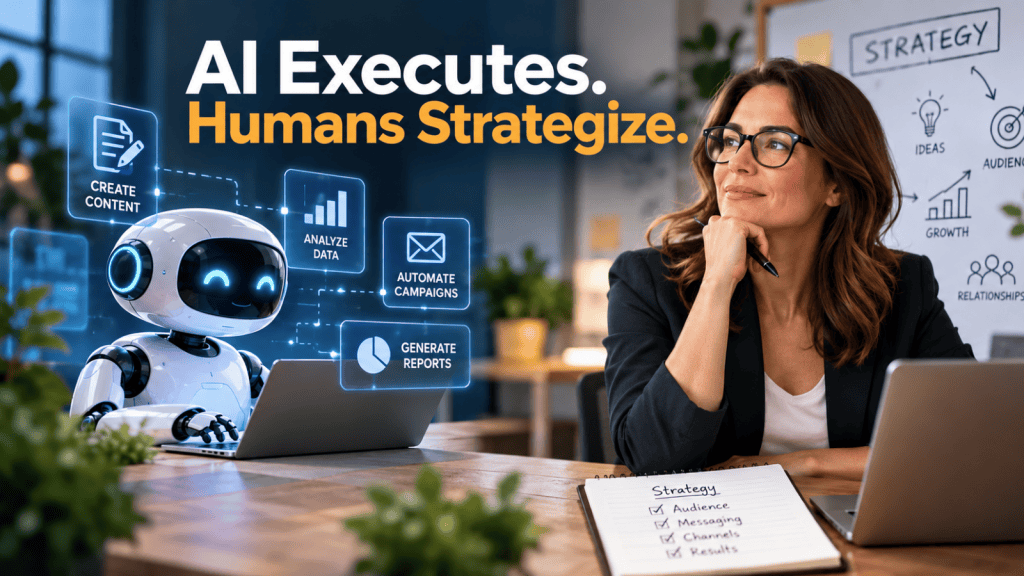
Artificial intelligence is transforming digital marketing, but successful marketing still requires human strategy, creativity, and relationships.
Artificial intelligence is changing how businesses approach marketing. From generating content and analyzing data to automating campaigns, AI makes marketing faster and more efficient.
But there’s an important distinction: Just because AI can execute marketing tasks doesn’t mean it should make the strategic decisions.
Recent research from digital marketing expert Neil Patel reinforces that idea.
What the Research Says About AI in Marketing
In September 2026, Neil Patel shared findings from a survey of 600 marketers examining which responsibilities should be handled by AI and which should remain human-led.
The findings revealed a clear preference for AI handling execution-focused activities:
- Personalization: 4.9 out of 5
- Research: 4.8 out of 5
- Reporting: 4.7 out of 5
- Content production: 3.9 out of 5
Meanwhile, marketers favored human involvement in strategic planning, creative direction, and customer relationships.
The survey generally used a scale of 1 (mostly human) to 5 (mostly AI).
The takeaway? Marketers increasingly trust AI to do the work, but still value human expertise to determine what work should be done and why.
Source: Neil Patel, AI Owns Execution, Not Strategy
AI Is a Powerful Tool, Not a Marketing Strategy
AI can write a social media post in seconds. But does that post reach the right audience?
AI can analyze website traffic. But does it understand why conversions increased or decreased?
AI can draft an email campaign. But does the message strengthen customer relationships?
These questions require strategic thinking.
At Dettmann Media, we believe technology should support marketing decisions, not replace the expertise behind them.
Producing more marketing content doesn’t necessarily mean producing better marketing results.
Where AI Can Make the Biggest Impact
Businesses and nonprofits can benefit from AI in several areas:
Marketing Analytics: Identify trends, summarize performance, and uncover opportunities using tools such as Google Analytics 4. Human interpretation helps turn those findings into actionable decisions.
Content Creation: Accelerate blog writing, social media development, and email campaigns while maintaining human oversight of messaging, accuracy, and brand voice.
Email Marketing: Support audience segmentation, personalization, and campaign optimization without losing the personal connections that build customer and donor loyalty.
Research and Planning: Gather information, explore opportunities, and evaluate marketing approaches while keeping strategic decisions in human hands.
The objective isn’t to automate everything. It’s to use AI where it creates meaningful value.
Why Human Strategy Still Matters
One of the biggest risks of relying too heavily on AI is confusing activity with results.
Publishing more content, sending more emails, and generating more reports won’t automatically increase sales, donations, or customer engagement.
Effective marketing begins with understanding your audience, establishing clear objectives, and measuring performance.
AI can help businesses work faster, but human expertise provides the context needed to make smarter decisions.
That’s especially important for small businesses and nonprofits, where trust, relationships, and limited resources play a significant role in marketing success.
The Best Approach: Human-Led Strategy, AI-Supported Execution
Rather than viewing AI as a replacement for marketers, businesses should approach it as a tool that strengthens their capabilities.
A practical approach includes:
- Define your goals. Identify the business outcomes your marketing should support.
- Develop your strategy. Understand your audience, messaging, and communication channels.
- Use AI for execution. Streamline research, content creation, reporting, and repetitive tasks.
- Review and refine. Apply human judgment to evaluate performance and improve results.
This combination allows businesses to benefit from AI’s efficiency without sacrificing creativity, authenticity, or strategic direction.
Final Thoughts: Let AI Handle the Work, Not the Vision
Artificial intelligence will continue to reshape digital marketing. Businesses that embrace it thoughtfully can gain advantages in efficiency, productivity, and analysis.
But technology alone doesn’t create a successful marketing strategy.
AI can help execute your marketing. Human expertise ensures that marketing has a purpose.
At Dettmann Media, we combine digital marketing strategy, analytics, and modern technology to help businesses and organizations turn marketing activity into measurable results.
Ready to make your marketing work smarter?
Visit DettmannMedia.com to learn how we can help strengthen your digital marketing strategy.











Leave a Reply