
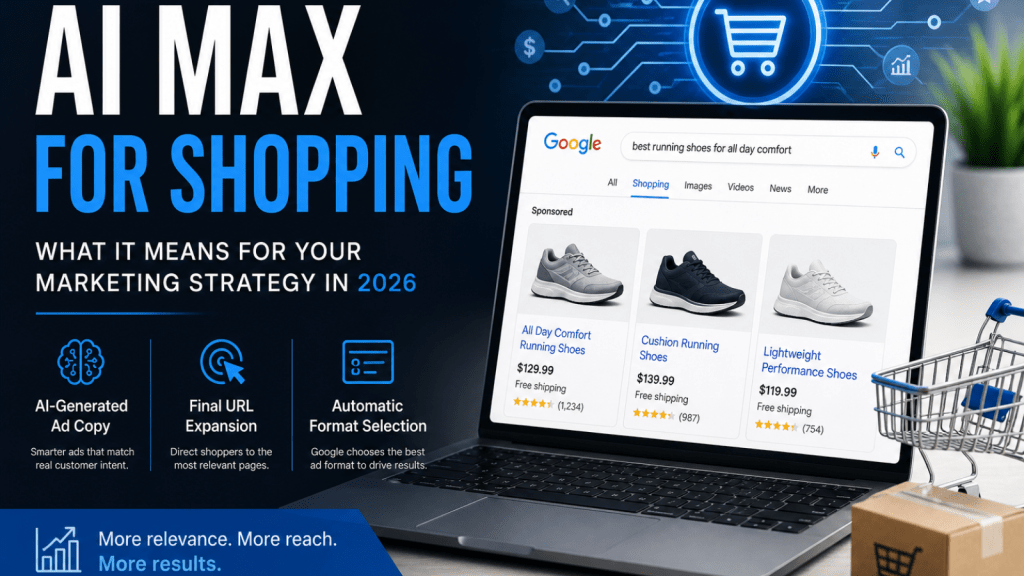
Google just made another major move in the shift toward AI-driven marketing and ecommerce.
With the launch of AI Max for Shopping, Google is signaling something bigger than just a feature update.
- The way people search, discover, and buy products is changing.
- And your marketing strategy needs to change with it.
Let’s break down what this actually means and what you should do about it.
ADDITIONAL RESOURCES
Adapt your Shopping campaigns to modern Search with AI Max
Google Cloud Next 2026: What Marketers and Businesses Need to Understand About the ‘Agentic Era’
Google Just Changed Search (Again): What AI Mode in Chrome Means for Your Marketing Strategy
The Modern Marketing Funnel: How AI Is Changing the Customer Journey
The Big Shift: From “Search” to “Discovery”
Traditionally, Shopping ads were built around product-based searches:
“Nike running shoes size 10”
“black office chair under $200”
But that’s not how people search anymore.
Today, shoppers are asking things like:
“Best comfortable shoes for standing all day”
“Affordable modern desk setup ideas”
Google is adapting to this shift by making ads smarter, more contextual, and more aligned with intent, not just keywords.
What AI Max for Shopping Actually Does
AI Max layers automation and intelligence onto your existing Shopping campaigns using your Merchant Center feed.
Here are the three biggest features:
AI-Generated Ad Copy
Google can now dynamically create ad text based on:
- Product attributes (material, fit, durability)
- Search intent
- Context of the query
This means your ads can match how people ask questions, not just what they type.
Final URL Expansion (FUE)
Instead of sending everyone to one product page, Google can route users to the most relevant page on your site based on intent.
Example:
- Search = “best ankle support for basketball”
- Landing page = category page or guide, not just a single product
Automatic Format Selection
Google chooses the best format in real time:
- Shopping ad
- Text ad
- Hybrid experience
Based on what’s most likely to convert for that user.
Dettmann Media Take: What You Should Do Right Now
If you’re running (or planning) shopping campaigns, here are the recommended next steps:
Upgrade Your Product Feed
Focus on:
- Rich product descriptions
- Attributes (materials, use cases, benefits)
- Clean, structured data
Think of it this way: “Would this help AI understand my product?”
Build Intent-Based Landing Pages
Don’t rely only on product pages. Instead, create …
- Category pages
- Buying guides
- Use-case content
This gives AI Max better destinations to match intent.
Align Messaging With Real Customer Questions
Look at:
- Search queries
- Customer questions
- Sales conversations
Then build content and product data around those.
Don’t Abandon Performance Max
AI Max for Shopping complements, not replaces, Performance Max.
The future is a hybrid AI-driven ecosystem, not one campaign type.
The Bottom Line
AI Max for Shopping confirms what we’ve been saying:
Marketing is shifting from manual control → AI-powered systems fueled by your data
The brands that win won’t be the ones with the most campaigns.
They’ll be the ones with:
- The best data
- The best structure
- The clearest understanding of customer intent
Google isn’t just changing ads. It’s changing how customers find you in the first place.
Turn AI-Driven Marketing Into Real Revenue
Most businesses won’t lose because they lack tools. They’ll lose because they don’t know how to use them strategically.
AI Max for Shopping is powerful, but it only works as well as the system behind it.
At Dettmann Media, we help businesses turn platforms like this into clear, measurable growth systems by focusing on:
- Clean, accurate tracking (so you know what’s actually working)
- Optimized product feeds and content that AI can understand
- Landing page strategies built around real customer intent
- Campaign structures designed to scale, not just run
No guesswork. No chasing trends. Just data-backed decisions that drive results.








Leave a comment