
For years, marketers have heard the same phrase:
“SEO is changing.”
Usually, that meant a new ranking factor, an algorithm update, or another shift in content quality standards.
But Google’s newest announcement feels fundamentally different.
At Google I/O 2026, the company unveiled what it called the “biggest upgrade” to Search in more than 25 years. The update introduces deeper AI integration, conversational search experiences, AI-powered agents, and search results that increasingly act more like an assistant than a traditional list of links.
And honestly?
This is probably the clearest signal yet that we are moving beyond “traditional SEO.”
Additional Resources
Google unveils biggest update to Search in 25 years, including AI agents
AI Max for Shopping: What It Means for Your Marketing Strategy in 2026
Google Cloud Next 2026: What Marketers and Businesses Need to Understand About the ‘Agentic Era’
Meta’s New Manus AI Tool Could Change Marketing Faster Than Any Algorithm Update
Search Is Becoming Action-Oriented
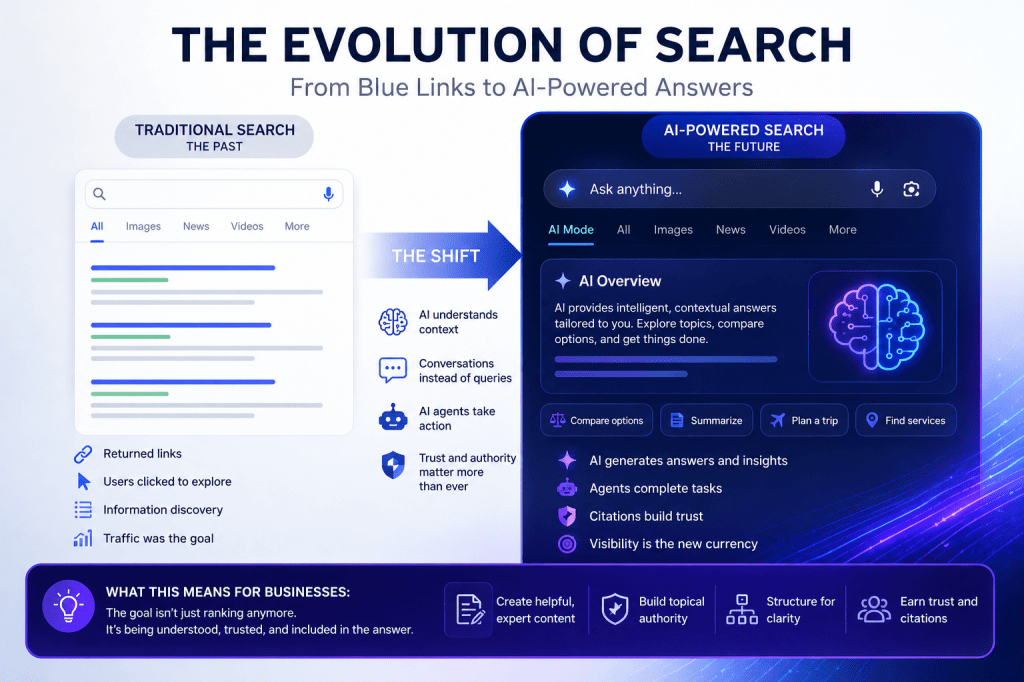
For most of Google’s history, search worked like a directory.
You searched.
Google returned links.
You clicked websites.
Now, Google is moving toward something different:
You ask.
Google interprets.
AI synthesizes.
Agents potentially act on your behalf.
That’s a major shift.
Google’s newest AI features aim to answer complex questions directly, continue conversations naturally, monitor information over time, and even complete tasks for users.
The search engine is becoming less of a search engine and more of a decision engine.
That changes marketing.
The Era of “Blue Links” Is Fading
This does not mean websites disappear.
But it does mean visibility changes.
Historically, businesses competed for:
- rankings
- clicks
- impressions
- traffic
Now, businesses may increasingly compete for:
- citations inside AI answers
- inclusion in AI summaries
- trust signals
- topical authority
- structured, machine-readable expertise
That’s a very different battlefield.
We’re already seeing evidence that AI-generated search experiences reduce the number of clicks users make to actual websites.
And while some businesses see that as alarming, I think it’s more accurate to view it as an evolution of digital discovery.
The businesses that adapt fastest will likely gain disproportionate visibility.
This Is Why “AI Optimization” Matters
At Dettmann Media, one of the biggest conversations I’ve been having lately is around what I often call:
“AIO” or AI Optimization.
Not replacing SEO.
Expanding beyond it.
Traditional SEO still matters:
- technical health
- page speed
- keyword relevance
- local optimization
- internal linking
- authority signals
But now we also have to think about:
- how AI systems interpret content
- how clearly expertise is communicated
- whether content answers layered questions
- whether entities, locations, services, and trust are easy for machines to understand
- whether your brand becomes a source AI systems trust
In other words:
The internet is shifting from “ranking pages” to “understanding context.”
Smaller Businesses Still Have an Opportunity
Ironically, this shift may actually create opportunities for smaller and mid-sized businesses.
Why?
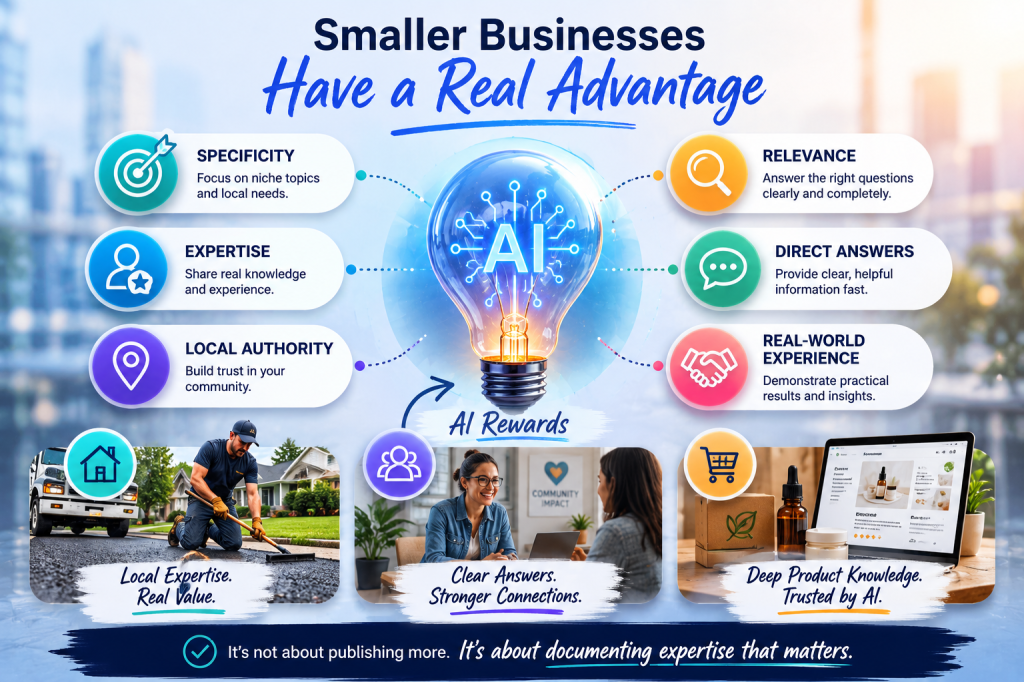
Because AI-driven search seems to reward:
- specificity
- expertise
- relevance
- local authority
- direct answers
- real-world experience
That means businesses with genuinely useful content may have a stronger chance to compete, even against larger brands.
A local asphalt contractor explaining Connecticut driveway maintenance.
A nonprofit answering donor questions clearly.
A niche ecommerce brand with deep product expertise.
Those are the types of signals AI systems increasingly value.
The businesses that document expertise well may outperform businesses that simply publish more content.
The Bigger Question Mark
There’s still uncertainty.
A lot of it.
Publishers are concerned about declining website traffic.
Marketers are questioning attribution.
Businesses are wondering what success metrics will even look like in two years.
Those concerns are valid.
Even recent research suggests AI Overviews are already reshaping how users interact with information online.
But regardless of where someone stands on AI, the direction is becoming increasingly clear:
Search is becoming conversational, predictive, and agent-driven.
And businesses that continue treating SEO like it’s still 2018 may struggle to stay visible.
My Perspective
I don’t think SEO is dying.
I think search behavior is evolving faster than most businesses realize.
The companies that win over the next few years likely won’t be the ones producing the most content.
They’ll be the ones building:
- clarity
- authority
- trust
- structure
- consistency
- expertise
Because in an AI-driven search world, being understandable may become just as important as being discoverable.
And that changes everything.









Leave a Reply