
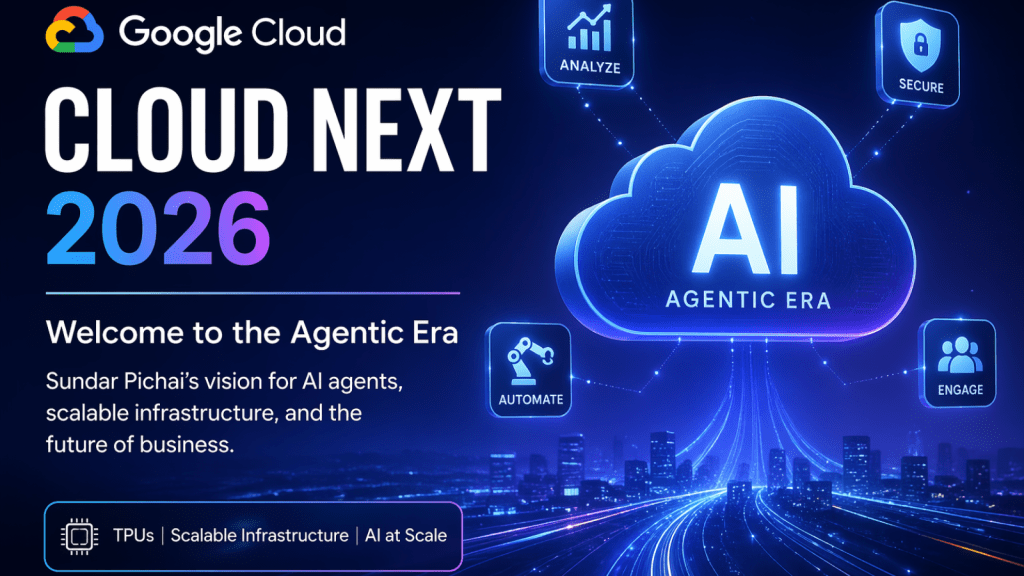
Google just made something very clear: we’re no longer entering the AI era… we’re entering the agentic era.
At Google Cloud Next 2026, CEO Sundar Pichai laid out a vision that shifts AI from a tool you use to a system that works for you. And for businesses, that’s a massive shift in how marketing, operations, and growth will function moving forward.
Let’s break down what actually matters and what you should do about it.
The Big Shift: From AI Tools to AI Agents
For the past couple of years, businesses have been asking:
“How do we use AI?”
Now the question is becoming:
“How do we manage AI systems that operate on our behalf?”
Google is leaning hard into this shift with what it calls the “agentic Gemini era.”
Instead of prompting ChatGPT-like tools, companies will build and manage AI agents that:
- Execute workflows
- Analyze data continuously
- Make decisions within defined guardrails
- Act across systems without manual input
This is a fundamental change. Businesses won’t just use AI. They’ll orchestrate it.
Additional Resources
Google Just Changed Search (Again): What AI Mode in Chrome Means for Your Marketing Strategy
Google Is Changing How Consent Works Between GA4 and Google Ads — Here’s What You Need to Know
Why This Matters: Scale Is Exploding
The numbers behind this announcement tell the real story:
- Google models are now processing 16+ billion tokens per minute
- Google Cloud is growing rapidly with massive enterprise demand
- The company is investing up to $175–$185 billion in AI infrastructure
That level of investment signals one thing:
AI is no longer experimental. It’s production infrastructure.
Even Google Cloud leadership said the “experimental phase is behind us” and the real challenge now is scaling AI across organizations.
The Real Innovation: Managing Thousands of Agents
One of the most overlooked insights from Pichai’s announcement:
The challenge isn’t building one AI agent.
It’s managing thousands of them.
Google is positioning its platform (Gemini + Cloud + infrastructure) as the control layer for:
- Internal workflows
- Customer experience automation
- Data analysis pipelines
- Security and threat detection
In other words, AI becomes infrastructure, not just software.
What This Means for Marketing and Growth
Here’s where this gets real for businesses and marketers.
1. Content Creation Becomes a System, Not a Task
AI won’t just help you write content.
It will:
- Generate
- Optimize
- Distribute
- Analyze performance
Continuously.
2. Search Is Changing Again
Google is evolving from a search engine into what Pichai described as more of an “agent manager.”
That means:
- Users won’t just search
- AI will act on their behalf
Think:
- Booking
- Buying
- Comparing
- Recommending
All without traditional clicks.
3. Your Data Becomes Your Advantage (or Weakness)
AI agents rely on:
- Clean data
- Connected systems
- Accurate tracking
If your analytics are broken or fragmented, your AI outputs will be too.
This is where most businesses will struggle.
What Businesses Should Do Right Now
If you’re thinking about how this applies to your organization, focus here:
1. Fix Your Data Foundation
- GA4 setup
- Event tracking
- Clean attribution
- Consistent naming conventions
Without this, AI will amplify bad data.
2. Build Repeatable Systems
Don’t just create content. Build systems for:
- Content production
- Distribution
- Measurement
- Optimization
3. Start Small with Automation
You don’t need 1,000 agents.
Start with:
- Email workflows
- Lead qualification
- Reporting automation
- Customer support
4. Think Like an Orchestrator
Your role is shifting from:
- Doing the work
To:
- Designing systems that do the work











Leave a Reply