
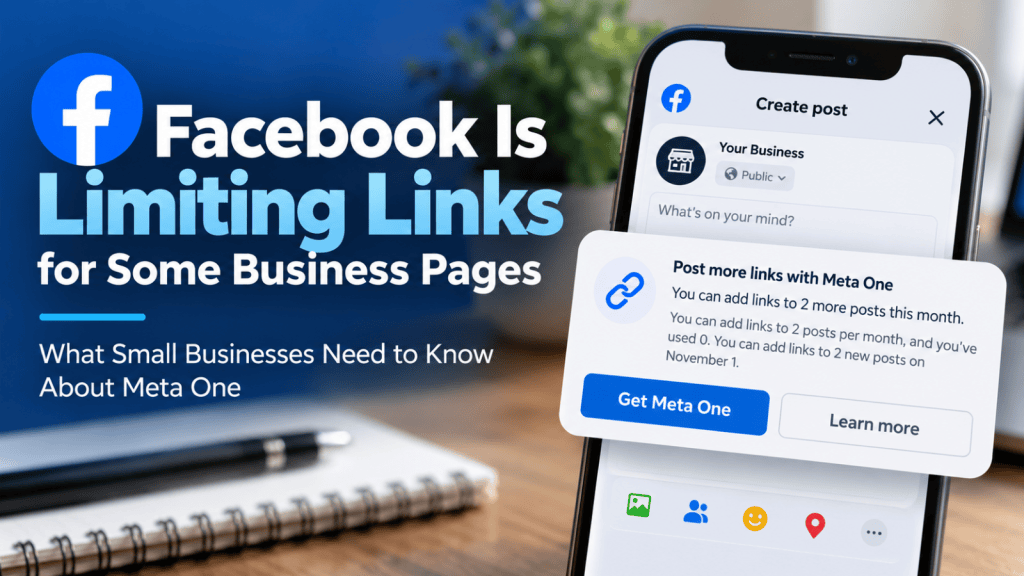
If you manage a Facebook business Page, you may have recently encountered a message you haven’t seen before:
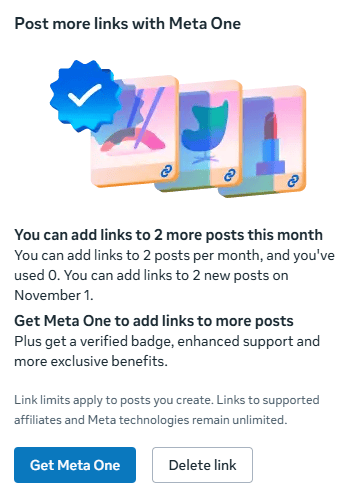
“You can add links to 2 more posts this month.”
That’s exactly what I encountered recently while creating a Facebook post for a business.
At first glance, it looks like a warning or perhaps a restriction placed on the Page. It’s neither.
It’s part of a new approach from Meta that could change how businesses use organic Facebook posts to drive traffic to their websites.
What’s changing with Facebook links?
Meta is testing limits on the number of organic Facebook posts containing external links that some Pages can publish.
For Pages included in the test, Meta is allowing two posts containing external links per month before prompting the business to subscribe to Meta One.
Meta One is Meta’s newer subscription offering that bundles additional features and benefits for creators and businesses.
The notice I received specifically stated that the Page could add links to two posts per month and that the allowance would reset at the beginning of the next month.
Meta also notes that links to supported Meta technologies and affiliates remain unlimited.
The important takeaway is that this doesn’t appear to be a punishment for violating Facebook’s rules. It’s a publishing limitation being introduced to certain Pages.
How new is this?
Very.
Meta announced Meta One in September 2026, and reports of the expanded external-link restrictions began appearing around the same time.
While Meta had previously experimented with limiting links for some Pages, the Meta One rollout is bringing significantly more attention to the issue.
That also means you shouldn’t assume every Facebook Page is going to see the same restriction immediately.
Meta frequently tests and gradually rolls out new features. If you manage multiple Pages, you may encounter the two-link limit on one Page while another continues operating normally.
Why does this matter for small businesses?
For many businesses, Facebook isn’t just about likes, comments and followers.
It’s also a distribution channel.
A business might publish a project update and link to its website. A contractor may share a completed project and link to a service page. A nonprofit may link to a donation page. A retailer may send followers directly to a product.
If businesses are limited to two organic posts containing external links each month, those links suddenly become much more valuable.
Instead of automatically adding a website link to every Facebook post, businesses may need to become more intentional about which posts are designed to generate website traffic.
Should you stop including links?
No.
But this is a good opportunity to reconsider the role links play in your social media strategy.
If your Page receives the two-link restriction, I would think about your content in two categories:
Engagement and awareness content can primarily live on Facebook. Before-and-after photos, company updates, educational tips, employee features, customer stories and other content don’t necessarily need an external link to accomplish their purpose.
Traffic and conversion content is where your limited external links become more important. Reserve those opportunities for posts where getting someone to your website is the primary objective, such as requesting a quote, registering for an event, reading an important article, making a donation or visiting a key landing page.
In other words, don’t use one of your limited links simply because you’ve always included your website at the bottom of every Facebook post.
Give the link a job.
What about putting the link in the comments?
That’s an obvious potential workaround, but I wouldn’t build a strategy around it.
Current documentation surrounding Meta’s test indicates that external links placed in comments may also be subject to the limitation.
As Meta continues testing the feature, businesses should expect the exact rules and implementation to evolve.
Should your business pay for Meta One?
Not necessarily.
A two-link limit may sound restrictive, but that doesn’t automatically mean every small business should add another monthly subscription.
First, look at your analytics.
How much website traffic does Facebook actually generate?
How many leads or sales originate from organic Facebook traffic?
How frequently do people click the links you’re currently posting?
If organic Facebook links are responsible for meaningful traffic and conversions, the additional publishing capabilities offered through Meta One may eventually be worth considering.
If they aren’t, paying simply to continue a posting habit may not make much business sense.
What I’d recommend businesses do now
If you encounter this message on your Facebook Page, don’t panic and don’t immediately subscribe.
Instead:
- Identify whether your Page is affected. The restriction is not necessarily appearing for every Page.
- Stop treating every social post as a website traffic post. Let awareness and engagement content do its job directly on Facebook.
- Reserve external links for high-value actions. Think leads, registrations, donations, purchases and strategically important website content.
- Review your Facebook referral traffic. GA4 can help determine whether Facebook is actually sending meaningful traffic to your website.
- Watch the rollout. This is a relatively new development, and Meta could adjust how the restriction works as it expands.
The bigger marketing lesson
Facebook’s new link restrictions are another reminder of something I regularly tell businesses:
You don’t own your social media audience.
Platforms can change their algorithms, features, reach and rules at any time.
Your website, email list, customer database and first-party analytics give your business much more control.
That doesn’t mean Facebook isn’t valuable. It means Facebook should be one piece of your marketing ecosystem, rather than the entire ecosystem.
If Meta makes it harder to send people away from Facebook organically, having a strong website, search presence, email strategy and measurement system becomes even more important.
And ultimately, that’s a healthier marketing strategy anyway.
Need help making sense of your digital marketing?
Dettmann Media helps businesses turn websites, social media, SEO and analytics into a practical marketing strategy built around measurable goals.









Leave a comment