
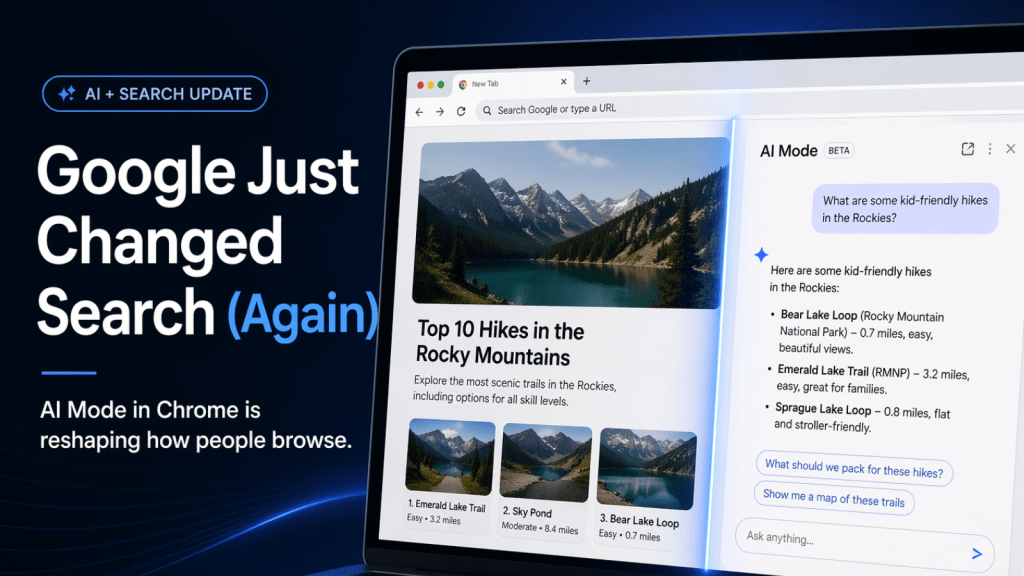
Google just took another big step toward an AI-first internet.
With its latest update to AI Mode in Chrome, Google is no longer just helping people search the web. It’s starting to sit alongside them while they explore it.
That changes everything.
Additional Resources
Google Is Changing How Consent Works Between GA4 and Google Ads — Here’s What You Need to Know
Meta’s New Manus AI Tool Could Change Marketing Faster Than Any Algorithm Update
Search Is Now Personal: What Google’s AI Mode Means for Marketers
What Google Actually Announced
At a high level, Google introduced a more integrated version of AI Mode inside Chrome.
Instead of bouncing between tabs, users can now:
- View AI responses and websites side-by-side
- Ask follow-up questions without leaving the page
- Have AI analyze multiple open tabs
- Add files, images, or context into the experience
In short, Google is trying to eliminate “tab hopping” and turn browsing into a continuous, AI-assisted experience.
The Bigger Shift: Search Is Becoming a Workspace
This isn’t just a feature update. It’s a behavioral shift.
Google is moving from:
Search Engine → Answer Engine → Research Assistant
AI Mode already acts like a conversational layer on top of search, breaking questions into subtopics and synthesizing answers across sources.
Now, inside Chrome, it becomes something more: A persistent assistant that stays with you as you browse.
That means users don’t just “search and click” anymore
They search, explore, ask, refine, compare, and decide… all in one place
Why This Matters for Marketers
This is where it gets real.
1. Fewer Clicks. More Filtering.
If AI Mode answers the question upfront, fewer users will click through to websites.
But the clicks that do happen? They’re more qualified.
Users are arriving after:
- Comparing options
- Asking follow-ups
- Narrowing intent
This reinforces a shift we’ve already been seeing: Traffic volume matters less. Traffic quality matters more.
2. Your Content Is Now Being “Used,” Not Just “Visited”
AI Mode doesn’t just rank content.
It:
- Reads it
- Extracts it
- Synthesizes it
- Repackages it
Your content becomes input for answers, not just a destination.
That means your content needs to be:
- Clear
- Structured
- Authoritative
- Easy to extract
If it’s vague or buried it won’t make the cut.
3. The Middle of the Funnel Is Expanding
Because users can explore and compare without leaving Chrome, more of the decision-making process happens before they reach your site.
That means:
- Awareness → Consideration → Decision is happening inside Google
- Your site becomes more of a conversion destination, not a discovery tool
4. Context Is the New Battleground
AI Mode can now:
- Look across tabs
- Incorporate files and images
- Understand user intent more deeply
That means generic content loses.
What wins:
- Specific answers
- Clear use cases
- Real-world examples
- Strong entity clarity (who you are, what you do, where you operate)
What You Should Do Right Now
You don’t need to panic. But you do need to adjust.
Here’s the playbook:
1. Build an “Answer Layer” Into Your Site
Every key page should clearly answer:
- What is this?
- Who is it for?
- Why does it matter?
(You’ve already been doing this with your SEO work. This just makes it more critical.)
2. Structure Content for Extraction
Think:
- Headings that match real questions
- Short, direct answers
- Supporting detail underneath
Make it easy for AI to pull your content into responses.
3. Double Down on Authority Signals
AI Mode prioritizes:
- Clear expertise
- Consistency
- Trust signals
That means:
- Case studies
- Testimonials
- Specific results
- Real examples
4. Track What Actually Drives Revenue
As clicks become less reliable, your focus should shift to:
- Conversion rate
- Qualified traffic
- Revenue per session
Not just:
- Sessions
- Impressions
- Rankings
The Bottom Line
Google isn’t just improving search.
It’s redefining how people interact with the internet.
AI Mode in Chrome signals a future where:
- Search is conversational
- Browsing is assisted
- Decisions happen faster
- Websites are part of the answer, not the starting point
For marketers, the goal is no longer just to “rank.” It’s to be included in the answer.











Leave a Reply