
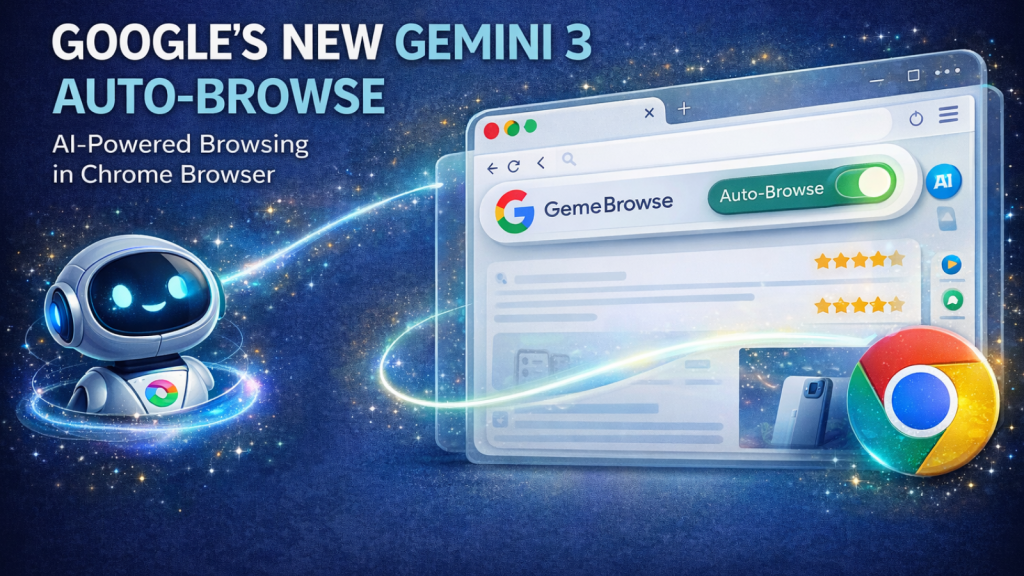
Google has introduced a major upgrade to Chrome, built on its most advanced AI model to date: Gemini 3. This set of features turns the browser into more than a tool for viewing web pages. It now acts as a proactive assistant that can help users complete complex online tasks, assist across apps, and enhance productivity right inside the browser.
Read full announcement: https://blog.google/products-and-platforms/products/chrome/gemini-3-auto-browse/
Here’s what that means for digital professionals and marketers in 2026 and beyond.
What Is Gemini 3 Auto Browse?
Traditionally, browsers have been passive tools: you search, click, fill a form, hit submit. With auto browse, that changes.
Auto browse allows Chrome’s Gemini AI to navigate websites for you, executing multi-step tasks such as:
- Filling out forms
- Scouring travel or shopping options across sites
- Comparing services or products
- Even applying budget constraints or criteria — all on your command
This next-generation browser experience is currently rolling out to Google AI Pro and Ultra subscribers in the U.S. and reflects a shift from reactive browsing to assistant-driven action.
Additional Resources
Search Is Now Personal: What Google’s AI Mode Means for Marketers
How AI Is Transforming Social Media Marketing
The Modern Marketing Funnel: How AI Is Changing the Customer Journey
New Side Panel Changes How You Multitask
A key part of the update is a redesign of the Chrome interface. A persistent side panel now hosts Gemini, giving users a companion workspace that stays open across tabs. From there, you can:
- Ask Gemini to summarize content
- Compare options or synthesize data from multiple tabs
- Keep your main workflow intact while working with the AI in parallel
Early tests show productivity gains for researchers, planners, and busy professionals juggling many tabs at once.
Practical Examples: What You Can Actually Do
The feature isn’t just theoretical. Demonstrations and Google testers have used auto browse to:
- Plan trips by finding the best flight and hotel options
- Schedule appointments and fill out digital forms
- Search for service provider quotes and compile results
- Plan activities using context from Gmail or Calendar
Because the engine is powered by Gemini 3’s multimodal intelligence, it can understand both text and images when navigating the web.
Integration With Google Apps
Chrome’s AI now works more deeply with other Google services. This means Gemini can pull context from:
- Gmail
- Google Calendar
- YouTube
- Maps
- Google Shopping and Flights
For marketers, this points to an evolution in how personal workflows and data can be woven into browsing tasks when permitted — and affects how users interact with search and content when AI is part of the browsing layer.
What It Means for Marketing and Search
For brands and SEO professionals, auto browse is big news because it highlights several trends:
AI as task assistant
Consumers may soon delegate shopping and research tasks to AI instead of manually clicking through search results.
New interaction surfaces
More search may happen via prompts in browser side panels rather than on traditional SERPs.
Context-aware experiences
Users could expect results personalized by their Gmail, Calendar, or browsing history (when opted in), which could change how content relevance is measured.
These shifts underscore the importance of structured data, clear conversion paths, and content optimized for AI understanding. As more users lean into this new browsing style, businesses that provide concise, answer-oriented content could see better visibility in AI-mediated results.
Get Ahead With AI-Ready Content Strategy
Here are actionable steps brands can take now:
- Audit your content for AI friendliness: structured formats, clear schema markup, concise answer blocks
- Anticipate multi-modal prompts by optimizing images with robust ALT text and descriptive captions
- Craft content that functions well both for human users and for AI task outputs
Chrome’s auto browse feature signals that the browser of the future won’t just deliver content; it will act on requests. Marketers that prepare for this AI-enabled experience early will gain a strategic advantage.










Leave a comment